




This post is also available in: Português (Portuguese (Portugal))
If there’s one issue dominating political conversations in Canada right now — whether in the media or around our dinner tables — it’s housing.
If there’s one issue dominating political conversations in Canada right now — whether in the media or around our dinner tables — it’s housing.
With prices at historic highs, a serious lack of supply, and population growth continuing at a fast pace, it’s no surprise that Canadians are feeling the pressure.
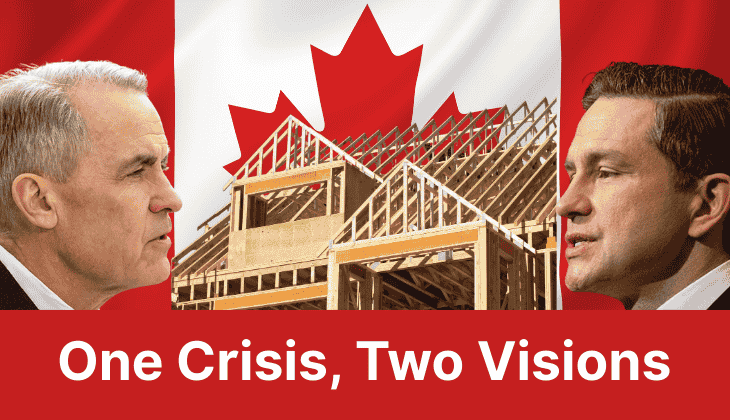
As we head toward the 2025 federal election, the two main candidates — Mark Carney (Liberals) and Pierre Poilievre (Conservatives) — are offering very different solutions to deal with the crisis. In this post, we’ll break down their main proposals, how they could affect your life, and leave you with one key question: Who’s actually going to get homes built?
The Liberal Plan – Mark Carney
Mark Carney, former Governor of the Bank of Canada, is putting forward an ambitious proposal that he calls a "Modern Housing Marshall Plan" — referring to the kind of major government-led investment used after World War II. His plan relies heavily on public leadership and spending.
Key points:
The thinking behind the plan: The federal government becomes an active player — coordinating with provinces and cities, investing directly, and working with the private sector to ramp up construction. The goal is to make the market fairer without leaving it entirely to private interests.
The Conservative Plan – Pierre Poilievre
Pierre Poilievre sees the housing crisis as a problem caused by too much bureaucracy and not enough accountability at the local level. His plan is built around removing obstacles and pressuring cities to build faster — with less government involvement overall.
Key points:
The thinking behind the plan: Cut the red tape, hold municipalities accountable, and let the private sector lead the way in solving the housing shortage.
What’s Really at Stake?
Despite the very different approaches, both parties agree on one thing: Canada needs to build a lot more housing — fast.
Where they differ is how they plan to make it happen:
So... Who’s Actually Going to Get Homes Built?
That’s the big question.
If you’ve got kids trying to buy a home, if you work in the trades, or if you simply want to see real solutions — these plans affect you.
Do you want more government investment, more public housing, and stronger coordination across the country?
Carney’s plan may speak to you.
Do you believe the private sector can build faster if government just gets out of the way?
Poilievre’s approach might be more convincing.
What Do You Think?
Leave a comment and share your thoughts.
Which of these plans feels like it could actually work?
Ganhos e Gastos — where we talk about money, housing, and the choices that affect our Luso-Canadian community.
Esta publicação também está disponível em português aqui.
With prices at historic highs, a serious lack of supply, and population growth continuing at a fast pace, it’s no surprise that Canadians are feeling the pressure.
If there’s one issue dominating political conversations in Canada right now — whether in the media or around our dinner tables — it’s housing.
With prices at historic highs, a serious lack of supply, and population growth continuing at a fast pace, it’s no surprise that Canadians are feeling the pressure.
As we head toward the 2025 federal election, the two main candidates — Mark Carney (Liberals) and Pierre Poilievre (Conservatives) — are offering very different solutions to deal with the crisis. In this post, we’ll break down their main proposals, how they could affect your life, and leave you with one key question: Who’s actually going to get homes built?
The Liberal Plan – Mark Carney
Mark Carney, former Governor of the Bank of Canada, is putting forward an ambitious proposal that he calls a "Modern Housing Marshall Plan" — referring to the kind of major government-led investment used after World War II. His plan relies heavily on public leadership and spending.
Key points:
The thinking behind the plan: The federal government becomes an active player — coordinating with provinces and cities, investing directly, and working with the private sector to ramp up construction. The goal is to make the market fairer without leaving it entirely to private interests.
The Conservative Plan – Pierre Poilievre
Pierre Poilievre sees the housing crisis as a problem caused by too much bureaucracy and not enough accountability at the local level. His plan is built around removing obstacles and pressuring cities to build faster — with less government involvement overall.
Key points:
The thinking behind the plan: Cut the red tape, hold municipalities accountable, and let the private sector lead the way in solving the housing shortage.
What’s Really at Stake?
Despite the very different approaches, both parties agree on one thing: Canada needs to build a lot more housing — fast.
Where they differ is how they plan to make it happen:
So... Who’s Actually Going to Get Homes Built?
That’s the big question.
If you’ve got kids trying to buy a home, if you work in the trades, or if you simply want to see real solutions — these plans affect you.
Do you want more government investment, more public housing, and stronger coordination across the country?
Carney’s plan may speak to you.
Do you believe the private sector can build faster if government just gets out of the way?
Poilievre’s approach might be more convincing.
What Do You Think?
Leave a comment and share your thoughts.
Which of these plans feels like it could actually work?
Ganhos e Gastos — where we talk about money, housing, and the choices that affect our Luso-Canadian community.
Esta publicação também está disponível em português aqui.
As we head toward the 2025 federal election, the two main candidates — Mark Carney (Liberals) and Pierre Poilievre (Conservatives) — are offering very different solutions to deal with the crisis. In this post, we’ll break down their main proposals, how they could affect your life, and leave you with one key question: Who’s actually going to get homes built?
If there’s one issue dominating political conversations in Canada right now — whether in the media or around our dinner tables — it’s housing.
With prices at historic highs, a serious lack of supply, and population growth continuing at a fast pace, it’s no surprise that Canadians are feeling the pressure.
As we head toward the 2025 federal election, the two main candidates — Mark Carney (Liberals) and Pierre Poilievre (Conservatives) — are offering very different solutions to deal with the crisis. In this post, we’ll break down their main proposals, how they could affect your life, and leave you with one key question: Who’s actually going to get homes built?
The Liberal Plan – Mark Carney
Mark Carney, former Governor of the Bank of Canada, is putting forward an ambitious proposal that he calls a "Modern Housing Marshall Plan" — referring to the kind of major government-led investment used after World War II. His plan relies heavily on public leadership and spending.
Key points:
The thinking behind the plan: The federal government becomes an active player — coordinating with provinces and cities, investing directly, and working with the private sector to ramp up construction. The goal is to make the market fairer without leaving it entirely to private interests.
The Conservative Plan – Pierre Poilievre
Pierre Poilievre sees the housing crisis as a problem caused by too much bureaucracy and not enough accountability at the local level. His plan is built around removing obstacles and pressuring cities to build faster — with less government involvement overall.
Key points:
The thinking behind the plan: Cut the red tape, hold municipalities accountable, and let the private sector lead the way in solving the housing shortage.
What’s Really at Stake?
Despite the very different approaches, both parties agree on one thing: Canada needs to build a lot more housing — fast.
Where they differ is how they plan to make it happen:
So... Who’s Actually Going to Get Homes Built?
That’s the big question.
If you’ve got kids trying to buy a home, if you work in the trades, or if you simply want to see real solutions — these plans affect you.
Do you want more government investment, more public housing, and stronger coordination across the country?
Carney’s plan may speak to you.
Do you believe the private sector can build faster if government just gets out of the way?
Poilievre’s approach might be more convincing.
What Do You Think?
Leave a comment and share your thoughts.
Which of these plans feels like it could actually work?
Ganhos e Gastos — where we talk about money, housing, and the choices that affect our Luso-Canadian community.
Esta publicação também está disponível em português aqui.
The Liberal Plan – Mark Carney
If there’s one issue dominating political conversations in Canada right now — whether in the media or around our dinner tables — it’s housing.
With prices at historic highs, a serious lack of supply, and population growth continuing at a fast pace, it’s no surprise that Canadians are feeling the pressure.
As we head toward the 2025 federal election, the two main candidates — Mark Carney (Liberals) and Pierre Poilievre (Conservatives) — are offering very different solutions to deal with the crisis. In this post, we’ll break down their main proposals, how they could affect your life, and leave you with one key question: Who’s actually going to get homes built?
The Liberal Plan – Mark Carney
Mark Carney, former Governor of the Bank of Canada, is putting forward an ambitious proposal that he calls a "Modern Housing Marshall Plan" — referring to the kind of major government-led investment used after World War II. His plan relies heavily on public leadership and spending.
Key points:
The thinking behind the plan: The federal government becomes an active player — coordinating with provinces and cities, investing directly, and working with the private sector to ramp up construction. The goal is to make the market fairer without leaving it entirely to private interests.
The Conservative Plan – Pierre Poilievre
Pierre Poilievre sees the housing crisis as a problem caused by too much bureaucracy and not enough accountability at the local level. His plan is built around removing obstacles and pressuring cities to build faster — with less government involvement overall.
Key points:
The thinking behind the plan: Cut the red tape, hold municipalities accountable, and let the private sector lead the way in solving the housing shortage.
What’s Really at Stake?
Despite the very different approaches, both parties agree on one thing: Canada needs to build a lot more housing — fast.
Where they differ is how they plan to make it happen:
So... Who’s Actually Going to Get Homes Built?
That’s the big question.
If you’ve got kids trying to buy a home, if you work in the trades, or if you simply want to see real solutions — these plans affect you.
Do you want more government investment, more public housing, and stronger coordination across the country?
Carney’s plan may speak to you.
Do you believe the private sector can build faster if government just gets out of the way?
Poilievre’s approach might be more convincing.
What Do You Think?
Leave a comment and share your thoughts.
Which of these plans feels like it could actually work?
Ganhos e Gastos — where we talk about money, housing, and the choices that affect our Luso-Canadian community.
Esta publicação também está disponível em português aqui.
Mark Carney, former Governor of the Bank of Canada, is putting forward an ambitious proposal that he calls a "Modern Housing Marshall Plan" — referring to the kind of major government-led investment used after World War II. His plan relies heavily on public leadership and spending.
If there’s one issue dominating political conversations in Canada right now — whether in the media or around our dinner tables — it’s housing.
With prices at historic highs, a serious lack of supply, and population growth continuing at a fast pace, it’s no surprise that Canadians are feeling the pressure.
As we head toward the 2025 federal election, the two main candidates — Mark Carney (Liberals) and Pierre Poilievre (Conservatives) — are offering very different solutions to deal with the crisis. In this post, we’ll break down their main proposals, how they could affect your life, and leave you with one key question: Who’s actually going to get homes built?
The Liberal Plan – Mark Carney
Mark Carney, former Governor of the Bank of Canada, is putting forward an ambitious proposal that he calls a "Modern Housing Marshall Plan" — referring to the kind of major government-led investment used after World War II. His plan relies heavily on public leadership and spending.
Key points:
The thinking behind the plan: The federal government becomes an active player — coordinating with provinces and cities, investing directly, and working with the private sector to ramp up construction. The goal is to make the market fairer without leaving it entirely to private interests.
The Conservative Plan – Pierre Poilievre
Pierre Poilievre sees the housing crisis as a problem caused by too much bureaucracy and not enough accountability at the local level. His plan is built around removing obstacles and pressuring cities to build faster — with less government involvement overall.
Key points:
The thinking behind the plan: Cut the red tape, hold municipalities accountable, and let the private sector lead the way in solving the housing shortage.
What’s Really at Stake?
Despite the very different approaches, both parties agree on one thing: Canada needs to build a lot more housing — fast.
Where they differ is how they plan to make it happen:
So... Who’s Actually Going to Get Homes Built?
That’s the big question.
If you’ve got kids trying to buy a home, if you work in the trades, or if you simply want to see real solutions — these plans affect you.
Do you want more government investment, more public housing, and stronger coordination across the country?
Carney’s plan may speak to you.
Do you believe the private sector can build faster if government just gets out of the way?
Poilievre’s approach might be more convincing.
What Do You Think?
Leave a comment and share your thoughts.
Which of these plans feels like it could actually work?
Ganhos e Gastos — where we talk about money, housing, and the choices that affect our Luso-Canadian community.
Esta publicação também está disponível em português aqui.
Key points:
If there’s one issue dominating political conversations in Canada right now — whether in the media or around our dinner tables — it’s housing.
With prices at historic highs, a serious lack of supply, and population growth continuing at a fast pace, it’s no surprise that Canadians are feeling the pressure.
As we head toward the 2025 federal election, the two main candidates — Mark Carney (Liberals) and Pierre Poilievre (Conservatives) — are offering very different solutions to deal with the crisis. In this post, we’ll break down their main proposals, how they could affect your life, and leave you with one key question: Who’s actually going to get homes built?
The Liberal Plan – Mark Carney
Mark Carney, former Governor of the Bank of Canada, is putting forward an ambitious proposal that he calls a "Modern Housing Marshall Plan" — referring to the kind of major government-led investment used after World War II. His plan relies heavily on public leadership and spending.
Key points:
The thinking behind the plan: The federal government becomes an active player — coordinating with provinces and cities, investing directly, and working with the private sector to ramp up construction. The goal is to make the market fairer without leaving it entirely to private interests.
The Conservative Plan – Pierre Poilievre
Pierre Poilievre sees the housing crisis as a problem caused by too much bureaucracy and not enough accountability at the local level. His plan is built around removing obstacles and pressuring cities to build faster — with less government involvement overall.
Key points:
The thinking behind the plan: Cut the red tape, hold municipalities accountable, and let the private sector lead the way in solving the housing shortage.
What’s Really at Stake?
Despite the very different approaches, both parties agree on one thing: Canada needs to build a lot more housing — fast.
Where they differ is how they plan to make it happen:
So... Who’s Actually Going to Get Homes Built?
That’s the big question.
If you’ve got kids trying to buy a home, if you work in the trades, or if you simply want to see real solutions — these plans affect you.
Do you want more government investment, more public housing, and stronger coordination across the country?
Carney’s plan may speak to you.
Do you believe the private sector can build faster if government just gets out of the way?
Poilievre’s approach might be more convincing.
What Do You Think?
Leave a comment and share your thoughts.
Which of these plans feels like it could actually work?
Ganhos e Gastos — where we talk about money, housing, and the choices that affect our Luso-Canadian community.
Esta publicação também está disponível em português aqui.
- A new federal agency (Build Canada Homes) to directly build housing, especially on public lands.
- A new federal agency (Build Canada Homes) to directly build housing, especially on public lands.
- $25 billion in support for factory-built, modular housing (faster and cheaper to produce).
- Remove the GST (sales tax) on new homes under $1 million — but only for first-time buyers.
- Bring back tax breaks for investors who build purpose-built rental housing (reviving the 1970s MURB program).
- Major investment in non-profit, co-op, and Indigenous-led housing.
- Support for skilled trades training and innovation in low-carbon building materials.
- Cities that fail to increase housing construction will lose access to federal funding.
- Bonuses for cities that exceed building targets.
- Eliminate the GST on new homes up to $1.3 million — for all buyers, not just first-time purchasers.
- A new tax rule that allows older Canadians to reinvest real estate profits into building more housing without paying capital gains tax (modeled on the U.S. 1031 exchange).
- Unlock 15% of federal land for housing within 18 months.
- Tie federal transit funding to housing density approvals — more homes = more funding.
- $25 billion in support for factory-built, modular housing (faster and cheaper to produce).
- A new federal agency (Build Canada Homes) to directly build housing, especially on public lands.
- $25 billion in support for factory-built, modular housing (faster and cheaper to produce).
- Remove the GST (sales tax) on new homes under $1 million — but only for first-time buyers.
- Bring back tax breaks for investors who build purpose-built rental housing (reviving the 1970s MURB program).
- Major investment in non-profit, co-op, and Indigenous-led housing.
- Support for skilled trades training and innovation in low-carbon building materials.
- Cities that fail to increase housing construction will lose access to federal funding.
- Bonuses for cities that exceed building targets.
- Eliminate the GST on new homes up to $1.3 million — for all buyers, not just first-time purchasers.
- A new tax rule that allows older Canadians to reinvest real estate profits into building more housing without paying capital gains tax (modeled on the U.S. 1031 exchange).
- Unlock 15% of federal land for housing within 18 months.
- Tie federal transit funding to housing density approvals — more homes = more funding.
- Remove the GST (sales tax) on new homes under $1 million — but only for first-time buyers.
- A new federal agency (Build Canada Homes) to directly build housing, especially on public lands.
- $25 billion in support for factory-built, modular housing (faster and cheaper to produce).
- Remove the GST (sales tax) on new homes under $1 million — but only for first-time buyers.
- Bring back tax breaks for investors who build purpose-built rental housing (reviving the 1970s MURB program).
- Major investment in non-profit, co-op, and Indigenous-led housing.
- Support for skilled trades training and innovation in low-carbon building materials.
- Cities that fail to increase housing construction will lose access to federal funding.
- Bonuses for cities that exceed building targets.
- Eliminate the GST on new homes up to $1.3 million — for all buyers, not just first-time purchasers.
- A new tax rule that allows older Canadians to reinvest real estate profits into building more housing without paying capital gains tax (modeled on the U.S. 1031 exchange).
- Unlock 15% of federal land for housing within 18 months.
- Tie federal transit funding to housing density approvals — more homes = more funding.
- Bring back tax breaks for investors who build purpose-built rental housing (reviving the 1970s MURB program).
- A new federal agency (Build Canada Homes) to directly build housing, especially on public lands.
- $25 billion in support for factory-built, modular housing (faster and cheaper to produce).
- Remove the GST (sales tax) on new homes under $1 million — but only for first-time buyers.
- Bring back tax breaks for investors who build purpose-built rental housing (reviving the 1970s MURB program).
- Major investment in non-profit, co-op, and Indigenous-led housing.
- Support for skilled trades training and innovation in low-carbon building materials.
- Cities that fail to increase housing construction will lose access to federal funding.
- Bonuses for cities that exceed building targets.
- Eliminate the GST on new homes up to $1.3 million — for all buyers, not just first-time purchasers.
- A new tax rule that allows older Canadians to reinvest real estate profits into building more housing without paying capital gains tax (modeled on the U.S. 1031 exchange).
- Unlock 15% of federal land for housing within 18 months.
- Tie federal transit funding to housing density approvals — more homes = more funding.
- Major investment in non-profit, co-op, and Indigenous-led housing.
- A new federal agency (Build Canada Homes) to directly build housing, especially on public lands.
- $25 billion in support for factory-built, modular housing (faster and cheaper to produce).
- Remove the GST (sales tax) on new homes under $1 million — but only for first-time buyers.
- Bring back tax breaks for investors who build purpose-built rental housing (reviving the 1970s MURB program).
- Major investment in non-profit, co-op, and Indigenous-led housing.
- Support for skilled trades training and innovation in low-carbon building materials.
- Cities that fail to increase housing construction will lose access to federal funding.
- Bonuses for cities that exceed building targets.
- Eliminate the GST on new homes up to $1.3 million — for all buyers, not just first-time purchasers.
- A new tax rule that allows older Canadians to reinvest real estate profits into building more housing without paying capital gains tax (modeled on the U.S. 1031 exchange).
- Unlock 15% of federal land for housing within 18 months.
- Tie federal transit funding to housing density approvals — more homes = more funding.
- Support for skilled trades training and innovation in low-carbon building materials.
- A new federal agency (Build Canada Homes) to directly build housing, especially on public lands.
- $25 billion in support for factory-built, modular housing (faster and cheaper to produce).
- Remove the GST (sales tax) on new homes under $1 million — but only for first-time buyers.
- Bring back tax breaks for investors who build purpose-built rental housing (reviving the 1970s MURB program).
- Major investment in non-profit, co-op, and Indigenous-led housing.
- Support for skilled trades training and innovation in low-carbon building materials.
- Cities that fail to increase housing construction will lose access to federal funding.
- Bonuses for cities that exceed building targets.
- Eliminate the GST on new homes up to $1.3 million — for all buyers, not just first-time purchasers.
- A new tax rule that allows older Canadians to reinvest real estate profits into building more housing without paying capital gains tax (modeled on the U.S. 1031 exchange).
- Unlock 15% of federal land for housing within 18 months.
- Tie federal transit funding to housing density approvals — more homes = more funding.
If there’s one issue dominating political conversations in Canada right now — whether in the media or around our dinner tables — it’s housing.
With prices at historic highs, a serious lack of supply, and population growth continuing at a fast pace, it’s no surprise that Canadians are feeling the pressure.
As we head toward the 2025 federal election, the two main candidates — Mark Carney (Liberals) and Pierre Poilievre (Conservatives) — are offering very different solutions to deal with the crisis. In this post, we’ll break down their main proposals, how they could affect your life, and leave you with one key question: Who’s actually going to get homes built?
The Liberal Plan – Mark Carney
Mark Carney, former Governor of the Bank of Canada, is putting forward an ambitious proposal that he calls a "Modern Housing Marshall Plan" — referring to the kind of major government-led investment used after World War II. His plan relies heavily on public leadership and spending.
Key points:
The thinking behind the plan: The federal government becomes an active player — coordinating with provinces and cities, investing directly, and working with the private sector to ramp up construction. The goal is to make the market fairer without leaving it entirely to private interests.
The Conservative Plan – Pierre Poilievre
Pierre Poilievre sees the housing crisis as a problem caused by too much bureaucracy and not enough accountability at the local level. His plan is built around removing obstacles and pressuring cities to build faster — with less government involvement overall.
Key points:
The thinking behind the plan: Cut the red tape, hold municipalities accountable, and let the private sector lead the way in solving the housing shortage.
What’s Really at Stake?
Despite the very different approaches, both parties agree on one thing: Canada needs to build a lot more housing — fast.
Where they differ is how they plan to make it happen:
So... Who’s Actually Going to Get Homes Built?
That’s the big question.
If you’ve got kids trying to buy a home, if you work in the trades, or if you simply want to see real solutions — these plans affect you.
Do you want more government investment, more public housing, and stronger coordination across the country?
Carney’s plan may speak to you.
Do you believe the private sector can build faster if government just gets out of the way?
Poilievre’s approach might be more convincing.
What Do You Think?
Leave a comment and share your thoughts.
Which of these plans feels like it could actually work?
Ganhos e Gastos — where we talk about money, housing, and the choices that affect our Luso-Canadian community.
Esta publicação também está disponível em português aqui.
If there’s one issue dominating political conversations in Canada right now — whether in the media or around our dinner tables — it’s housing.
With prices at historic highs, a serious lack of supply, and population growth continuing at a fast pace, it’s no surprise that Canadians are feeling the pressure.
As we head toward the 2025 federal election, the two main candidates — Mark Carney (Liberals) and Pierre Poilievre (Conservatives) — are offering very different solutions to deal with the crisis. In this post, we’ll break down their main proposals, how they could affect your life, and leave you with one key question: Who’s actually going to get homes built?
The Liberal Plan – Mark Carney
Mark Carney, former Governor of the Bank of Canada, is putting forward an ambitious proposal that he calls a "Modern Housing Marshall Plan" — referring to the kind of major government-led investment used after World War II. His plan relies heavily on public leadership and spending.
Key points:
The thinking behind the plan: The federal government becomes an active player — coordinating with provinces and cities, investing directly, and working with the private sector to ramp up construction. The goal is to make the market fairer without leaving it entirely to private interests.
The Conservative Plan – Pierre Poilievre
Pierre Poilievre sees the housing crisis as a problem caused by too much bureaucracy and not enough accountability at the local level. His plan is built around removing obstacles and pressuring cities to build faster — with less government involvement overall.
Key points:
The thinking behind the plan: Cut the red tape, hold municipalities accountable, and let the private sector lead the way in solving the housing shortage.
What’s Really at Stake?
Despite the very different approaches, both parties agree on one thing: Canada needs to build a lot more housing — fast.
Where they differ is how they plan to make it happen:
So... Who’s Actually Going to Get Homes Built?
That’s the big question.
If you’ve got kids trying to buy a home, if you work in the trades, or if you simply want to see real solutions — these plans affect you.
Do you want more government investment, more public housing, and stronger coordination across the country?
Carney’s plan may speak to you.
Do you believe the private sector can build faster if government just gets out of the way?
Poilievre’s approach might be more convincing.
What Do You Think?
Leave a comment and share your thoughts.
Which of these plans feels like it could actually work?
Ganhos e Gastos — where we talk about money, housing, and the choices that affect our Luso-Canadian community.
Esta publicação também está disponível em português aqui.
If there’s one issue dominating political conversations in Canada right now — whether in the media or around our dinner tables — it’s housing.
With prices at historic highs, a serious lack of supply, and population growth continuing at a fast pace, it’s no surprise that Canadians are feeling the pressure.
As we head toward the 2025 federal election, the two main candidates — Mark Carney (Liberals) and Pierre Poilievre (Conservatives) — are offering very different solutions to deal with the crisis. In this post, we’ll break down their main proposals, how they could affect your life, and leave you with one key question: Who’s actually going to get homes built?
The Liberal Plan – Mark Carney
Mark Carney, former Governor of the Bank of Canada, is putting forward an ambitious proposal that he calls a "Modern Housing Marshall Plan" — referring to the kind of major government-led investment used after World War II. His plan relies heavily on public leadership and spending.
Key points:
The thinking behind the plan: The federal government becomes an active player — coordinating with provinces and cities, investing directly, and working with the private sector to ramp up construction. The goal is to make the market fairer without leaving it entirely to private interests.
The Conservative Plan – Pierre Poilievre
Pierre Poilievre sees the housing crisis as a problem caused by too much bureaucracy and not enough accountability at the local level. His plan is built around removing obstacles and pressuring cities to build faster — with less government involvement overall.
Key points:
The thinking behind the plan: Cut the red tape, hold municipalities accountable, and let the private sector lead the way in solving the housing shortage.
What’s Really at Stake?
Despite the very different approaches, both parties agree on one thing: Canada needs to build a lot more housing — fast.
Where they differ is how they plan to make it happen:
So... Who’s Actually Going to Get Homes Built?
That’s the big question.
If you’ve got kids trying to buy a home, if you work in the trades, or if you simply want to see real solutions — these plans affect you.
Do you want more government investment, more public housing, and stronger coordination across the country?
Carney’s plan may speak to you.
Do you believe the private sector can build faster if government just gets out of the way?
Poilievre’s approach might be more convincing.
What Do You Think?
Leave a comment and share your thoughts.
Which of these plans feels like it could actually work?
Ganhos e Gastos — where we talk about money, housing, and the choices that affect our Luso-Canadian community.
Esta publicação também está disponível em português aqui.
If there’s one issue dominating political conversations in Canada right now — whether in the media or around our dinner tables — it’s housing.
With prices at historic highs, a serious lack of supply, and population growth continuing at a fast pace, it’s no surprise that Canadians are feeling the pressure.
As we head toward the 2025 federal election, the two main candidates — Mark Carney (Liberals) and Pierre Poilievre (Conservatives) — are offering very different solutions to deal with the crisis. In this post, we’ll break down their main proposals, how they could affect your life, and leave you with one key question: Who’s actually going to get homes built?
The Liberal Plan – Mark Carney
Mark Carney, former Governor of the Bank of Canada, is putting forward an ambitious proposal that he calls a "Modern Housing Marshall Plan" — referring to the kind of major government-led investment used after World War II. His plan relies heavily on public leadership and spending.
Key points:
The thinking behind the plan: The federal government becomes an active player — coordinating with provinces and cities, investing directly, and working with the private sector to ramp up construction. The goal is to make the market fairer without leaving it entirely to private interests.
The Conservative Plan – Pierre Poilievre
Pierre Poilievre sees the housing crisis as a problem caused by too much bureaucracy and not enough accountability at the local level. His plan is built around removing obstacles and pressuring cities to build faster — with less government involvement overall.
Key points:
The thinking behind the plan: Cut the red tape, hold municipalities accountable, and let the private sector lead the way in solving the housing shortage.
What’s Really at Stake?
Despite the very different approaches, both parties agree on one thing: Canada needs to build a lot more housing — fast.
Where they differ is how they plan to make it happen:
So... Who’s Actually Going to Get Homes Built?
That’s the big question.
If you’ve got kids trying to buy a home, if you work in the trades, or if you simply want to see real solutions — these plans affect you.
Do you want more government investment, more public housing, and stronger coordination across the country?
Carney’s plan may speak to you.
Do you believe the private sector can build faster if government just gets out of the way?
Poilievre’s approach might be more convincing.
What Do You Think?
Leave a comment and share your thoughts.
Which of these plans feels like it could actually work?
Ganhos e Gastos — where we talk about money, housing, and the choices that affect our Luso-Canadian community.
Esta publicação também está disponível em português aqui.
If there’s one issue dominating political conversations in Canada right now — whether in the media or around our dinner tables — it’s housing.
With prices at historic highs, a serious lack of supply, and population growth continuing at a fast pace, it’s no surprise that Canadians are feeling the pressure.
As we head toward the 2025 federal election, the two main candidates — Mark Carney (Liberals) and Pierre Poilievre (Conservatives) — are offering very different solutions to deal with the crisis. In this post, we’ll break down their main proposals, how they could affect your life, and leave you with one key question: Who’s actually going to get homes built?
The Liberal Plan – Mark Carney
Mark Carney, former Governor of the Bank of Canada, is putting forward an ambitious proposal that he calls a "Modern Housing Marshall Plan" — referring to the kind of major government-led investment used after World War II. His plan relies heavily on public leadership and spending.
Key points:
The thinking behind the plan: The federal government becomes an active player — coordinating with provinces and cities, investing directly, and working with the private sector to ramp up construction. The goal is to make the market fairer without leaving it entirely to private interests.
The Conservative Plan – Pierre Poilievre
Pierre Poilievre sees the housing crisis as a problem caused by too much bureaucracy and not enough accountability at the local level. His plan is built around removing obstacles and pressuring cities to build faster — with less government involvement overall.
Key points:
The thinking behind the plan: Cut the red tape, hold municipalities accountable, and let the private sector lead the way in solving the housing shortage.
What’s Really at Stake?
Despite the very different approaches, both parties agree on one thing: Canada needs to build a lot more housing — fast.
Where they differ is how they plan to make it happen:
So... Who’s Actually Going to Get Homes Built?
That’s the big question.
If you’ve got kids trying to buy a home, if you work in the trades, or if you simply want to see real solutions — these plans affect you.
Do you want more government investment, more public housing, and stronger coordination across the country?
Carney’s plan may speak to you.
Do you believe the private sector can build faster if government just gets out of the way?
Poilievre’s approach might be more convincing.
What Do You Think?
Leave a comment and share your thoughts.
Which of these plans feels like it could actually work?
Ganhos e Gastos — where we talk about money, housing, and the choices that affect our Luso-Canadian community.
Esta publicação também está disponível em português aqui.
If there’s one issue dominating political conversations in Canada right now — whether in the media or around our dinner tables — it’s housing.
With prices at historic highs, a serious lack of supply, and population growth continuing at a fast pace, it’s no surprise that Canadians are feeling the pressure.
As we head toward the 2025 federal election, the two main candidates — Mark Carney (Liberals) and Pierre Poilievre (Conservatives) — are offering very different solutions to deal with the crisis. In this post, we’ll break down their main proposals, how they could affect your life, and leave you with one key question: Who’s actually going to get homes built?
The Liberal Plan – Mark Carney
Mark Carney, former Governor of the Bank of Canada, is putting forward an ambitious proposal that he calls a "Modern Housing Marshall Plan" — referring to the kind of major government-led investment used after World War II. His plan relies heavily on public leadership and spending.
Key points:
The thinking behind the plan: The federal government becomes an active player — coordinating with provinces and cities, investing directly, and working with the private sector to ramp up construction. The goal is to make the market fairer without leaving it entirely to private interests.
The Conservative Plan – Pierre Poilievre
Pierre Poilievre sees the housing crisis as a problem caused by too much bureaucracy and not enough accountability at the local level. His plan is built around removing obstacles and pressuring cities to build faster — with less government involvement overall.
Key points:
The thinking behind the plan: Cut the red tape, hold municipalities accountable, and let the private sector lead the way in solving the housing shortage.
What’s Really at Stake?
Despite the very different approaches, both parties agree on one thing: Canada needs to build a lot more housing — fast.
Where they differ is how they plan to make it happen:
So... Who’s Actually Going to Get Homes Built?
That’s the big question.
If you’ve got kids trying to buy a home, if you work in the trades, or if you simply want to see real solutions — these plans affect you.
Do you want more government investment, more public housing, and stronger coordination across the country?
Carney’s plan may speak to you.
Do you believe the private sector can build faster if government just gets out of the way?
Poilievre’s approach might be more convincing.
What Do You Think?
Leave a comment and share your thoughts.
Which of these plans feels like it could actually work?
Ganhos e Gastos — where we talk about money, housing, and the choices that affect our Luso-Canadian community.
Esta publicação também está disponível em português aqui.
The thinking behind the plan: The federal government becomes an active player — coordinating with provinces and cities, investing directly, and working with the private sector to ramp up construction. The goal is to make the market fairer without leaving it entirely to private interests.
If there’s one issue dominating political conversations in Canada right now — whether in the media or around our dinner tables — it’s housing.
With prices at historic highs, a serious lack of supply, and population growth continuing at a fast pace, it’s no surprise that Canadians are feeling the pressure.
As we head toward the 2025 federal election, the two main candidates — Mark Carney (Liberals) and Pierre Poilievre (Conservatives) — are offering very different solutions to deal with the crisis. In this post, we’ll break down their main proposals, how they could affect your life, and leave you with one key question: Who’s actually going to get homes built?
The Liberal Plan – Mark Carney
Mark Carney, former Governor of the Bank of Canada, is putting forward an ambitious proposal that he calls a "Modern Housing Marshall Plan" — referring to the kind of major government-led investment used after World War II. His plan relies heavily on public leadership and spending.
Key points:
The thinking behind the plan: The federal government becomes an active player — coordinating with provinces and cities, investing directly, and working with the private sector to ramp up construction. The goal is to make the market fairer without leaving it entirely to private interests.
The Conservative Plan – Pierre Poilievre
Pierre Poilievre sees the housing crisis as a problem caused by too much bureaucracy and not enough accountability at the local level. His plan is built around removing obstacles and pressuring cities to build faster — with less government involvement overall.
Key points:
The thinking behind the plan: Cut the red tape, hold municipalities accountable, and let the private sector lead the way in solving the housing shortage.
What’s Really at Stake?
Despite the very different approaches, both parties agree on one thing: Canada needs to build a lot more housing — fast.
Where they differ is how they plan to make it happen:
So... Who’s Actually Going to Get Homes Built?
That’s the big question.
If you’ve got kids trying to buy a home, if you work in the trades, or if you simply want to see real solutions — these plans affect you.
Do you want more government investment, more public housing, and stronger coordination across the country?
Carney’s plan may speak to you.
Do you believe the private sector can build faster if government just gets out of the way?
Poilievre’s approach might be more convincing.
What Do You Think?
Leave a comment and share your thoughts.
Which of these plans feels like it could actually work?
Ganhos e Gastos — where we talk about money, housing, and the choices that affect our Luso-Canadian community.
Esta publicação também está disponível em português aqui.
The Conservative Plan – Pierre Poilievre
If there’s one issue dominating political conversations in Canada right now — whether in the media or around our dinner tables — it’s housing.
With prices at historic highs, a serious lack of supply, and population growth continuing at a fast pace, it’s no surprise that Canadians are feeling the pressure.
As we head toward the 2025 federal election, the two main candidates — Mark Carney (Liberals) and Pierre Poilievre (Conservatives) — are offering very different solutions to deal with the crisis. In this post, we’ll break down their main proposals, how they could affect your life, and leave you with one key question: Who’s actually going to get homes built?
The Liberal Plan – Mark Carney
Mark Carney, former Governor of the Bank of Canada, is putting forward an ambitious proposal that he calls a "Modern Housing Marshall Plan" — referring to the kind of major government-led investment used after World War II. His plan relies heavily on public leadership and spending.
Key points:
The thinking behind the plan: The federal government becomes an active player — coordinating with provinces and cities, investing directly, and working with the private sector to ramp up construction. The goal is to make the market fairer without leaving it entirely to private interests.
The Conservative Plan – Pierre Poilievre
Pierre Poilievre sees the housing crisis as a problem caused by too much bureaucracy and not enough accountability at the local level. His plan is built around removing obstacles and pressuring cities to build faster — with less government involvement overall.
Key points:
The thinking behind the plan: Cut the red tape, hold municipalities accountable, and let the private sector lead the way in solving the housing shortage.
What’s Really at Stake?
Despite the very different approaches, both parties agree on one thing: Canada needs to build a lot more housing — fast.
Where they differ is how they plan to make it happen:
So... Who’s Actually Going to Get Homes Built?
That’s the big question.
If you’ve got kids trying to buy a home, if you work in the trades, or if you simply want to see real solutions — these plans affect you.
Do you want more government investment, more public housing, and stronger coordination across the country?
Carney’s plan may speak to you.
Do you believe the private sector can build faster if government just gets out of the way?
Poilievre’s approach might be more convincing.
What Do You Think?
Leave a comment and share your thoughts.
Which of these plans feels like it could actually work?
Ganhos e Gastos — where we talk about money, housing, and the choices that affect our Luso-Canadian community.
Esta publicação também está disponível em português aqui.
Pierre Poilievre sees the housing crisis as a problem caused by too much bureaucracy and not enough accountability at the local level. His plan is built around removing obstacles and pressuring cities to build faster — with less government involvement overall.
If there’s one issue dominating political conversations in Canada right now — whether in the media or around our dinner tables — it’s housing.
With prices at historic highs, a serious lack of supply, and population growth continuing at a fast pace, it’s no surprise that Canadians are feeling the pressure.
As we head toward the 2025 federal election, the two main candidates — Mark Carney (Liberals) and Pierre Poilievre (Conservatives) — are offering very different solutions to deal with the crisis. In this post, we’ll break down their main proposals, how they could affect your life, and leave you with one key question: Who’s actually going to get homes built?
The Liberal Plan – Mark Carney
Mark Carney, former Governor of the Bank of Canada, is putting forward an ambitious proposal that he calls a "Modern Housing Marshall Plan" — referring to the kind of major government-led investment used after World War II. His plan relies heavily on public leadership and spending.
Key points:
The thinking behind the plan: The federal government becomes an active player — coordinating with provinces and cities, investing directly, and working with the private sector to ramp up construction. The goal is to make the market fairer without leaving it entirely to private interests.
The Conservative Plan – Pierre Poilievre
Pierre Poilievre sees the housing crisis as a problem caused by too much bureaucracy and not enough accountability at the local level. His plan is built around removing obstacles and pressuring cities to build faster — with less government involvement overall.
Key points:
The thinking behind the plan: Cut the red tape, hold municipalities accountable, and let the private sector lead the way in solving the housing shortage.
What’s Really at Stake?
Despite the very different approaches, both parties agree on one thing: Canada needs to build a lot more housing — fast.
Where they differ is how they plan to make it happen:
So... Who’s Actually Going to Get Homes Built?
That’s the big question.
If you’ve got kids trying to buy a home, if you work in the trades, or if you simply want to see real solutions — these plans affect you.
Do you want more government investment, more public housing, and stronger coordination across the country?
Carney’s plan may speak to you.
Do you believe the private sector can build faster if government just gets out of the way?
Poilievre’s approach might be more convincing.
What Do You Think?
Leave a comment and share your thoughts.
Which of these plans feels like it could actually work?
Ganhos e Gastos — where we talk about money, housing, and the choices that affect our Luso-Canadian community.
Esta publicação também está disponível em português aqui.
Key points:
If there’s one issue dominating political conversations in Canada right now — whether in the media or around our dinner tables — it’s housing.
With prices at historic highs, a serious lack of supply, and population growth continuing at a fast pace, it’s no surprise that Canadians are feeling the pressure.
As we head toward the 2025 federal election, the two main candidates — Mark Carney (Liberals) and Pierre Poilievre (Conservatives) — are offering very different solutions to deal with the crisis. In this post, we’ll break down their main proposals, how they could affect your life, and leave you with one key question: Who’s actually going to get homes built?
The Liberal Plan – Mark Carney
Mark Carney, former Governor of the Bank of Canada, is putting forward an ambitious proposal that he calls a "Modern Housing Marshall Plan" — referring to the kind of major government-led investment used after World War II. His plan relies heavily on public leadership and spending.
Key points:
The thinking behind the plan: The federal government becomes an active player — coordinating with provinces and cities, investing directly, and working with the private sector to ramp up construction. The goal is to make the market fairer without leaving it entirely to private interests.
The Conservative Plan – Pierre Poilievre
Pierre Poilievre sees the housing crisis as a problem caused by too much bureaucracy and not enough accountability at the local level. His plan is built around removing obstacles and pressuring cities to build faster — with less government involvement overall.
Key points:
The thinking behind the plan: Cut the red tape, hold municipalities accountable, and let the private sector lead the way in solving the housing shortage.
What’s Really at Stake?
Despite the very different approaches, both parties agree on one thing: Canada needs to build a lot more housing — fast.
Where they differ is how they plan to make it happen:
So... Who’s Actually Going to Get Homes Built?
That’s the big question.
If you’ve got kids trying to buy a home, if you work in the trades, or if you simply want to see real solutions — these plans affect you.
Do you want more government investment, more public housing, and stronger coordination across the country?
Carney’s plan may speak to you.
Do you believe the private sector can build faster if government just gets out of the way?
Poilievre’s approach might be more convincing.
What Do You Think?
Leave a comment and share your thoughts.
Which of these plans feels like it could actually work?
Ganhos e Gastos — where we talk about money, housing, and the choices that affect our Luso-Canadian community.
Esta publicação também está disponível em português aqui.
- Cities that fail to increase housing construction will lose access to federal funding.
- A new federal agency (Build Canada Homes) to directly build housing, especially on public lands.
- $25 billion in support for factory-built, modular housing (faster and cheaper to produce).
- Remove the GST (sales tax) on new homes under $1 million — but only for first-time buyers.
- Bring back tax breaks for investors who build purpose-built rental housing (reviving the 1970s MURB program).
- Major investment in non-profit, co-op, and Indigenous-led housing.
- Support for skilled trades training and innovation in low-carbon building materials.
- Cities that fail to increase housing construction will lose access to federal funding.
- Bonuses for cities that exceed building targets.
- Eliminate the GST on new homes up to $1.3 million — for all buyers, not just first-time purchasers.
- A new tax rule that allows older Canadians to reinvest real estate profits into building more housing without paying capital gains tax (modeled on the U.S. 1031 exchange).
- Unlock 15% of federal land for housing within 18 months.
- Tie federal transit funding to housing density approvals — more homes = more funding.
- Bonuses for cities that exceed building targets.
- A new federal agency (Build Canada Homes) to directly build housing, especially on public lands.
- $25 billion in support for factory-built, modular housing (faster and cheaper to produce).
- Remove the GST (sales tax) on new homes under $1 million — but only for first-time buyers.
- Bring back tax breaks for investors who build purpose-built rental housing (reviving the 1970s MURB program).
- Major investment in non-profit, co-op, and Indigenous-led housing.
- Support for skilled trades training and innovation in low-carbon building materials.
- Cities that fail to increase housing construction will lose access to federal funding.
- Bonuses for cities that exceed building targets.
- Eliminate the GST on new homes up to $1.3 million — for all buyers, not just first-time purchasers.
- A new tax rule that allows older Canadians to reinvest real estate profits into building more housing without paying capital gains tax (modeled on the U.S. 1031 exchange).
- Unlock 15% of federal land for housing within 18 months.
- Tie federal transit funding to housing density approvals — more homes = more funding.
- Eliminate the GST on new homes up to $1.3 million — for all buyers, not just first-time purchasers.
- A new federal agency (Build Canada Homes) to directly build housing, especially on public lands.
- $25 billion in support for factory-built, modular housing (faster and cheaper to produce).
- Remove the GST (sales tax) on new homes under $1 million — but only for first-time buyers.
- Bring back tax breaks for investors who build purpose-built rental housing (reviving the 1970s MURB program).
- Major investment in non-profit, co-op, and Indigenous-led housing.
- Support for skilled trades training and innovation in low-carbon building materials.
- Cities that fail to increase housing construction will lose access to federal funding.
- Bonuses for cities that exceed building targets.
- Eliminate the GST on new homes up to $1.3 million — for all buyers, not just first-time purchasers.
- A new tax rule that allows older Canadians to reinvest real estate profits into building more housing without paying capital gains tax (modeled on the U.S. 1031 exchange).
- Unlock 15% of federal land for housing within 18 months.
- Tie federal transit funding to housing density approvals — more homes = more funding.
- A new tax rule that allows older Canadians to reinvest real estate profits into building more housing without paying capital gains tax (modeled on the U.S. 1031 exchange).
- A new federal agency (Build Canada Homes) to directly build housing, especially on public lands.
- $25 billion in support for factory-built, modular housing (faster and cheaper to produce).
- Remove the GST (sales tax) on new homes under $1 million — but only for first-time buyers.
- Bring back tax breaks for investors who build purpose-built rental housing (reviving the 1970s MURB program).
- Major investment in non-profit, co-op, and Indigenous-led housing.
- Support for skilled trades training and innovation in low-carbon building materials.
- Cities that fail to increase housing construction will lose access to federal funding.
- Bonuses for cities that exceed building targets.
- Eliminate the GST on new homes up to $1.3 million — for all buyers, not just first-time purchasers.
- A new tax rule that allows older Canadians to reinvest real estate profits into building more housing without paying capital gains tax (modeled on the U.S. 1031 exchange).
- Unlock 15% of federal land for housing within 18 months.
- Tie federal transit funding to housing density approvals — more homes = more funding.
- Unlock 15% of federal land for housing within 18 months.
- A new federal agency (Build Canada Homes) to directly build housing, especially on public lands.
- $25 billion in support for factory-built, modular housing (faster and cheaper to produce).
- Remove the GST (sales tax) on new homes under $1 million — but only for first-time buyers.
- Bring back tax breaks for investors who build purpose-built rental housing (reviving the 1970s MURB program).
- Major investment in non-profit, co-op, and Indigenous-led housing.
- Support for skilled trades training and innovation in low-carbon building materials.
- Cities that fail to increase housing construction will lose access to federal funding.
- Bonuses for cities that exceed building targets.
- Eliminate the GST on new homes up to $1.3 million — for all buyers, not just first-time purchasers.
- A new tax rule that allows older Canadians to reinvest real estate profits into building more housing without paying capital gains tax (modeled on the U.S. 1031 exchange).
- Unlock 15% of federal land for housing within 18 months.
- Tie federal transit funding to housing density approvals — more homes = more funding.
- Tie federal transit funding to housing density approvals — more homes = more funding.
- A new federal agency (Build Canada Homes) to directly build housing, especially on public lands.
- $25 billion in support for factory-built, modular housing (faster and cheaper to produce).
- Remove the GST (sales tax) on new homes under $1 million — but only for first-time buyers.
- Bring back tax breaks for investors who build purpose-built rental housing (reviving the 1970s MURB program).
- Major investment in non-profit, co-op, and Indigenous-led housing.
- Support for skilled trades training and innovation in low-carbon building materials.
- Cities that fail to increase housing construction will lose access to federal funding.
- Bonuses for cities that exceed building targets.
- Eliminate the GST on new homes up to $1.3 million — for all buyers, not just first-time purchasers.
- A new tax rule that allows older Canadians to reinvest real estate profits into building more housing without paying capital gains tax (modeled on the U.S. 1031 exchange).
- Unlock 15% of federal land for housing within 18 months.
- Tie federal transit funding to housing density approvals — more homes = more funding.
If there’s one issue dominating political conversations in Canada right now — whether in the media or around our dinner tables — it’s housing.
With prices at historic highs, a serious lack of supply, and population growth continuing at a fast pace, it’s no surprise that Canadians are feeling the pressure.
As we head toward the 2025 federal election, the two main candidates — Mark Carney (Liberals) and Pierre Poilievre (Conservatives) — are offering very different solutions to deal with the crisis. In this post, we’ll break down their main proposals, how they could affect your life, and leave you with one key question: Who’s actually going to get homes built?
The Liberal Plan – Mark Carney
Mark Carney, former Governor of the Bank of Canada, is putting forward an ambitious proposal that he calls a "Modern Housing Marshall Plan" — referring to the kind of major government-led investment used after World War II. His plan relies heavily on public leadership and spending.
Key points:
The thinking behind the plan: The federal government becomes an active player — coordinating with provinces and cities, investing directly, and working with the private sector to ramp up construction. The goal is to make the market fairer without leaving it entirely to private interests.
The Conservative Plan – Pierre Poilievre
Pierre Poilievre sees the housing crisis as a problem caused by too much bureaucracy and not enough accountability at the local level. His plan is built around removing obstacles and pressuring cities to build faster — with less government involvement overall.
Key points:
The thinking behind the plan: Cut the red tape, hold municipalities accountable, and let the private sector lead the way in solving the housing shortage.
What’s Really at Stake?
Despite the very different approaches, both parties agree on one thing: Canada needs to build a lot more housing — fast.
Where they differ is how they plan to make it happen:
So... Who’s Actually Going to Get Homes Built?
That’s the big question.
If you’ve got kids trying to buy a home, if you work in the trades, or if you simply want to see real solutions — these plans affect you.
Do you want more government investment, more public housing, and stronger coordination across the country?
Carney’s plan may speak to you.
Do you believe the private sector can build faster if government just gets out of the way?
Poilievre’s approach might be more convincing.
What Do You Think?
Leave a comment and share your thoughts.
Which of these plans feels like it could actually work?
Ganhos e Gastos — where we talk about money, housing, and the choices that affect our Luso-Canadian community.
Esta publicação também está disponível em português aqui.
If there’s one issue dominating political conversations in Canada right now — whether in the media or around our dinner tables — it’s housing.
With prices at historic highs, a serious lack of supply, and population growth continuing at a fast pace, it’s no surprise that Canadians are feeling the pressure.
As we head toward the 2025 federal election, the two main candidates — Mark Carney (Liberals) and Pierre Poilievre (Conservatives) — are offering very different solutions to deal with the crisis. In this post, we’ll break down their main proposals, how they could affect your life, and leave you with one key question: Who’s actually going to get homes built?
The Liberal Plan – Mark Carney
Mark Carney, former Governor of the Bank of Canada, is putting forward an ambitious proposal that he calls a "Modern Housing Marshall Plan" — referring to the kind of major government-led investment used after World War II. His plan relies heavily on public leadership and spending.
Key points:
The thinking behind the plan: The federal government becomes an active player — coordinating with provinces and cities, investing directly, and working with the private sector to ramp up construction. The goal is to make the market fairer without leaving it entirely to private interests.
The Conservative Plan – Pierre Poilievre
Pierre Poilievre sees the housing crisis as a problem caused by too much bureaucracy and not enough accountability at the local level. His plan is built around removing obstacles and pressuring cities to build faster — with less government involvement overall.
Key points:
The thinking behind the plan: Cut the red tape, hold municipalities accountable, and let the private sector lead the way in solving the housing shortage.
What’s Really at Stake?
Despite the very different approaches, both parties agree on one thing: Canada needs to build a lot more housing — fast.
Where they differ is how they plan to make it happen:
So... Who’s Actually Going to Get Homes Built?
That’s the big question.
If you’ve got kids trying to buy a home, if you work in the trades, or if you simply want to see real solutions — these plans affect you.
Do you want more government investment, more public housing, and stronger coordination across the country?
Carney’s plan may speak to you.
Do you believe the private sector can build faster if government just gets out of the way?
Poilievre’s approach might be more convincing.
What Do You Think?
Leave a comment and share your thoughts.
Which of these plans feels like it could actually work?
Ganhos e Gastos — where we talk about money, housing, and the choices that affect our Luso-Canadian community.
Esta publicação também está disponível em português aqui.
If there’s one issue dominating political conversations in Canada right now — whether in the media or around our dinner tables — it’s housing.
With prices at historic highs, a serious lack of supply, and population growth continuing at a fast pace, it’s no surprise that Canadians are feeling the pressure.
As we head toward the 2025 federal election, the two main candidates — Mark Carney (Liberals) and Pierre Poilievre (Conservatives) — are offering very different solutions to deal with the crisis. In this post, we’ll break down their main proposals, how they could affect your life, and leave you with one key question: Who’s actually going to get homes built?
The Liberal Plan – Mark Carney
Mark Carney, former Governor of the Bank of Canada, is putting forward an ambitious proposal that he calls a "Modern Housing Marshall Plan" — referring to the kind of major government-led investment used after World War II. His plan relies heavily on public leadership and spending.
Key points:
The thinking behind the plan: The federal government becomes an active player — coordinating with provinces and cities, investing directly, and working with the private sector to ramp up construction. The goal is to make the market fairer without leaving it entirely to private interests.
The Conservative Plan – Pierre Poilievre
Pierre Poilievre sees the housing crisis as a problem caused by too much bureaucracy and not enough accountability at the local level. His plan is built around removing obstacles and pressuring cities to build faster — with less government involvement overall.
Key points:
The thinking behind the plan: Cut the red tape, hold municipalities accountable, and let the private sector lead the way in solving the housing shortage.
What’s Really at Stake?
Despite the very different approaches, both parties agree on one thing: Canada needs to build a lot more housing — fast.
Where they differ is how they plan to make it happen:
So... Who’s Actually Going to Get Homes Built?
That’s the big question.
If you’ve got kids trying to buy a home, if you work in the trades, or if you simply want to see real solutions — these plans affect you.
Do you want more government investment, more public housing, and stronger coordination across the country?
Carney’s plan may speak to you.
Do you believe the private sector can build faster if government just gets out of the way?
Poilievre’s approach might be more convincing.
What Do You Think?
Leave a comment and share your thoughts.
Which of these plans feels like it could actually work?
Ganhos e Gastos — where we talk about money, housing, and the choices that affect our Luso-Canadian community.
Esta publicação também está disponível em português aqui.
If there’s one issue dominating political conversations in Canada right now — whether in the media or around our dinner tables — it’s housing.
With prices at historic highs, a serious lack of supply, and population growth continuing at a fast pace, it’s no surprise that Canadians are feeling the pressure.
As we head toward the 2025 federal election, the two main candidates — Mark Carney (Liberals) and Pierre Poilievre (Conservatives) — are offering very different solutions to deal with the crisis. In this post, we’ll break down their main proposals, how they could affect your life, and leave you with one key question: Who’s actually going to get homes built?
The Liberal Plan – Mark Carney
Mark Carney, former Governor of the Bank of Canada, is putting forward an ambitious proposal that he calls a "Modern Housing Marshall Plan" — referring to the kind of major government-led investment used after World War II. His plan relies heavily on public leadership and spending.
Key points:
The thinking behind the plan: The federal government becomes an active player — coordinating with provinces and cities, investing directly, and working with the private sector to ramp up construction. The goal is to make the market fairer without leaving it entirely to private interests.
The Conservative Plan – Pierre Poilievre
Pierre Poilievre sees the housing crisis as a problem caused by too much bureaucracy and not enough accountability at the local level. His plan is built around removing obstacles and pressuring cities to build faster — with less government involvement overall.
Key points:
The thinking behind the plan: Cut the red tape, hold municipalities accountable, and let the private sector lead the way in solving the housing shortage.
What’s Really at Stake?
Despite the very different approaches, both parties agree on one thing: Canada needs to build a lot more housing — fast.
Where they differ is how they plan to make it happen:
So... Who’s Actually Going to Get Homes Built?
That’s the big question.
If you’ve got kids trying to buy a home, if you work in the trades, or if you simply want to see real solutions — these plans affect you.
Do you want more government investment, more public housing, and stronger coordination across the country?
Carney’s plan may speak to you.
Do you believe the private sector can build faster if government just gets out of the way?
Poilievre’s approach might be more convincing.
What Do You Think?
Leave a comment and share your thoughts.
Which of these plans feels like it could actually work?
Ganhos e Gastos — where we talk about money, housing, and the choices that affect our Luso-Canadian community.
Esta publicação também está disponível em português aqui.
If there’s one issue dominating political conversations in Canada right now — whether in the media or around our dinner tables — it’s housing.
With prices at historic highs, a serious lack of supply, and population growth continuing at a fast pace, it’s no surprise that Canadians are feeling the pressure.
As we head toward the 2025 federal election, the two main candidates — Mark Carney (Liberals) and Pierre Poilievre (Conservatives) — are offering very different solutions to deal with the crisis. In this post, we’ll break down their main proposals, how they could affect your life, and leave you with one key question: Who’s actually going to get homes built?
The Liberal Plan – Mark Carney
Mark Carney, former Governor of the Bank of Canada, is putting forward an ambitious proposal that he calls a "Modern Housing Marshall Plan" — referring to the kind of major government-led investment used after World War II. His plan relies heavily on public leadership and spending.
Key points:
The thinking behind the plan: The federal government becomes an active player — coordinating with provinces and cities, investing directly, and working with the private sector to ramp up construction. The goal is to make the market fairer without leaving it entirely to private interests.
The Conservative Plan – Pierre Poilievre
Pierre Poilievre sees the housing crisis as a problem caused by too much bureaucracy and not enough accountability at the local level. His plan is built around removing obstacles and pressuring cities to build faster — with less government involvement overall.
Key points:
The thinking behind the plan: Cut the red tape, hold municipalities accountable, and let the private sector lead the way in solving the housing shortage.
What’s Really at Stake?
Despite the very different approaches, both parties agree on one thing: Canada needs to build a lot more housing — fast.
Where they differ is how they plan to make it happen:
So... Who’s Actually Going to Get Homes Built?
That’s the big question.
If you’ve got kids trying to buy a home, if you work in the trades, or if you simply want to see real solutions — these plans affect you.
Do you want more government investment, more public housing, and stronger coordination across the country?
Carney’s plan may speak to you.
Do you believe the private sector can build faster if government just gets out of the way?
Poilievre’s approach might be more convincing.
What Do You Think?
Leave a comment and share your thoughts.
Which of these plans feels like it could actually work?
Ganhos e Gastos — where we talk about money, housing, and the choices that affect our Luso-Canadian community.
Esta publicação também está disponível em português aqui.
If there’s one issue dominating political conversations in Canada right now — whether in the media or around our dinner tables — it’s housing.
With prices at historic highs, a serious lack of supply, and population growth continuing at a fast pace, it’s no surprise that Canadians are feeling the pressure.
As we head toward the 2025 federal election, the two main candidates — Mark Carney (Liberals) and Pierre Poilievre (Conservatives) — are offering very different solutions to deal with the crisis. In this post, we’ll break down their main proposals, how they could affect your life, and leave you with one key question: Who’s actually going to get homes built?
The Liberal Plan – Mark Carney
Mark Carney, former Governor of the Bank of Canada, is putting forward an ambitious proposal that he calls a "Modern Housing Marshall Plan" — referring to the kind of major government-led investment used after World War II. His plan relies heavily on public leadership and spending.
Key points:
The thinking behind the plan: The federal government becomes an active player — coordinating with provinces and cities, investing directly, and working with the private sector to ramp up construction. The goal is to make the market fairer without leaving it entirely to private interests.
The Conservative Plan – Pierre Poilievre
Pierre Poilievre sees the housing crisis as a problem caused by too much bureaucracy and not enough accountability at the local level. His plan is built around removing obstacles and pressuring cities to build faster — with less government involvement overall.
Key points:
The thinking behind the plan: Cut the red tape, hold municipalities accountable, and let the private sector lead the way in solving the housing shortage.
What’s Really at Stake?
Despite the very different approaches, both parties agree on one thing: Canada needs to build a lot more housing — fast.
Where they differ is how they plan to make it happen:
So... Who’s Actually Going to Get Homes Built?
That’s the big question.
If you’ve got kids trying to buy a home, if you work in the trades, or if you simply want to see real solutions — these plans affect you.
Do you want more government investment, more public housing, and stronger coordination across the country?
Carney’s plan may speak to you.
Do you believe the private sector can build faster if government just gets out of the way?
Poilievre’s approach might be more convincing.
What Do You Think?
Leave a comment and share your thoughts.
Which of these plans feels like it could actually work?
Ganhos e Gastos — where we talk about money, housing, and the choices that affect our Luso-Canadian community.
Esta publicação também está disponível em português aqui.
The thinking behind the plan: Cut the red tape, hold municipalities accountable, and let the private sector lead the way in solving the housing shortage.
If there’s one issue dominating political conversations in Canada right now — whether in the media or around our dinner tables — it’s housing.
With prices at historic highs, a serious lack of supply, and population growth continuing at a fast pace, it’s no surprise that Canadians are feeling the pressure.
As we head toward the 2025 federal election, the two main candidates — Mark Carney (Liberals) and Pierre Poilievre (Conservatives) — are offering very different solutions to deal with the crisis. In this post, we’ll break down their main proposals, how they could affect your life, and leave you with one key question: Who’s actually going to get homes built?
The Liberal Plan – Mark Carney
Mark Carney, former Governor of the Bank of Canada, is putting forward an ambitious proposal that he calls a "Modern Housing Marshall Plan" — referring to the kind of major government-led investment used after World War II. His plan relies heavily on public leadership and spending.
Key points:
The thinking behind the plan: The federal government becomes an active player — coordinating with provinces and cities, investing directly, and working with the private sector to ramp up construction. The goal is to make the market fairer without leaving it entirely to private interests.
The Conservative Plan – Pierre Poilievre
Pierre Poilievre sees the housing crisis as a problem caused by too much bureaucracy and not enough accountability at the local level. His plan is built around removing obstacles and pressuring cities to build faster — with less government involvement overall.
Key points:
The thinking behind the plan: Cut the red tape, hold municipalities accountable, and let the private sector lead the way in solving the housing shortage.
What’s Really at Stake?
Despite the very different approaches, both parties agree on one thing: Canada needs to build a lot more housing — fast.
Where they differ is how they plan to make it happen:
So... Who’s Actually Going to Get Homes Built?
That’s the big question.
If you’ve got kids trying to buy a home, if you work in the trades, or if you simply want to see real solutions — these plans affect you.
Do you want more government investment, more public housing, and stronger coordination across the country?
Carney’s plan may speak to you.
Do you believe the private sector can build faster if government just gets out of the way?
Poilievre’s approach might be more convincing.
What Do You Think?
Leave a comment and share your thoughts.
Which of these plans feels like it could actually work?
Ganhos e Gastos — where we talk about money, housing, and the choices that affect our Luso-Canadian community.
Esta publicação também está disponível em português aqui.
What’s Really at Stake?
If there’s one issue dominating political conversations in Canada right now — whether in the media or around our dinner tables — it’s housing.
With prices at historic highs, a serious lack of supply, and population growth continuing at a fast pace, it’s no surprise that Canadians are feeling the pressure.
As we head toward the 2025 federal election, the two main candidates — Mark Carney (Liberals) and Pierre Poilievre (Conservatives) — are offering very different solutions to deal with the crisis. In this post, we’ll break down their main proposals, how they could affect your life, and leave you with one key question: Who’s actually going to get homes built?
The Liberal Plan – Mark Carney
Mark Carney, former Governor of the Bank of Canada, is putting forward an ambitious proposal that he calls a "Modern Housing Marshall Plan" — referring to the kind of major government-led investment used after World War II. His plan relies heavily on public leadership and spending.
Key points:
The thinking behind the plan: The federal government becomes an active player — coordinating with provinces and cities, investing directly, and working with the private sector to ramp up construction. The goal is to make the market fairer without leaving it entirely to private interests.
The Conservative Plan – Pierre Poilievre
Pierre Poilievre sees the housing crisis as a problem caused by too much bureaucracy and not enough accountability at the local level. His plan is built around removing obstacles and pressuring cities to build faster — with less government involvement overall.
Key points:
The thinking behind the plan: Cut the red tape, hold municipalities accountable, and let the private sector lead the way in solving the housing shortage.
What’s Really at Stake?
Despite the very different approaches, both parties agree on one thing: Canada needs to build a lot more housing — fast.
Where they differ is how they plan to make it happen:
So... Who’s Actually Going to Get Homes Built?
That’s the big question.
If you’ve got kids trying to buy a home, if you work in the trades, or if you simply want to see real solutions — these plans affect you.
Do you want more government investment, more public housing, and stronger coordination across the country?
Carney’s plan may speak to you.
Do you believe the private sector can build faster if government just gets out of the way?
Poilievre’s approach might be more convincing.
What Do You Think?
Leave a comment and share your thoughts.
Which of these plans feels like it could actually work?
Ganhos e Gastos — where we talk about money, housing, and the choices that affect our Luso-Canadian community.
Esta publicação também está disponível em português aqui.
Despite the very different approaches, both parties agree on one thing: Canada needs to build a lot more housing — fast.
If there’s one issue dominating political conversations in Canada right now — whether in the media or around our dinner tables — it’s housing.
With prices at historic highs, a serious lack of supply, and population growth continuing at a fast pace, it’s no surprise that Canadians are feeling the pressure.
As we head toward the 2025 federal election, the two main candidates — Mark Carney (Liberals) and Pierre Poilievre (Conservatives) — are offering very different solutions to deal with the crisis. In this post, we’ll break down their main proposals, how they could affect your life, and leave you with one key question: Who’s actually going to get homes built?
The Liberal Plan – Mark Carney
Mark Carney, former Governor of the Bank of Canada, is putting forward an ambitious proposal that he calls a "Modern Housing Marshall Plan" — referring to the kind of major government-led investment used after World War II. His plan relies heavily on public leadership and spending.
Key points:
The thinking behind the plan: The federal government becomes an active player — coordinating with provinces and cities, investing directly, and working with the private sector to ramp up construction. The goal is to make the market fairer without leaving it entirely to private interests.
The Conservative Plan – Pierre Poilievre
Pierre Poilievre sees the housing crisis as a problem caused by too much bureaucracy and not enough accountability at the local level. His plan is built around removing obstacles and pressuring cities to build faster — with less government involvement overall.
Key points:
The thinking behind the plan: Cut the red tape, hold municipalities accountable, and let the private sector lead the way in solving the housing shortage.
What’s Really at Stake?
Despite the very different approaches, both parties agree on one thing: Canada needs to build a lot more housing — fast.
Where they differ is how they plan to make it happen:
So... Who’s Actually Going to Get Homes Built?
That’s the big question.
If you’ve got kids trying to buy a home, if you work in the trades, or if you simply want to see real solutions — these plans affect you.
Do you want more government investment, more public housing, and stronger coordination across the country?
Carney’s plan may speak to you.
Do you believe the private sector can build faster if government just gets out of the way?
Poilievre’s approach might be more convincing.
What Do You Think?
Leave a comment and share your thoughts.
Which of these plans feels like it could actually work?
Ganhos e Gastos — where we talk about money, housing, and the choices that affect our Luso-Canadian community.
Esta publicação também está disponível em português aqui.
Where they differ is how they plan to make it happen:
If there’s one issue dominating political conversations in Canada right now — whether in the media or around our dinner tables — it’s housing.
With prices at historic highs, a serious lack of supply, and population growth continuing at a fast pace, it’s no surprise that Canadians are feeling the pressure.
As we head toward the 2025 federal election, the two main candidates — Mark Carney (Liberals) and Pierre Poilievre (Conservatives) — are offering very different solutions to deal with the crisis. In this post, we’ll break down their main proposals, how they could affect your life, and leave you with one key question: Who’s actually going to get homes built?
The Liberal Plan – Mark Carney
Mark Carney, former Governor of the Bank of Canada, is putting forward an ambitious proposal that he calls a "Modern Housing Marshall Plan" — referring to the kind of major government-led investment used after World War II. His plan relies heavily on public leadership and spending.
Key points:
The thinking behind the plan: The federal government becomes an active player — coordinating with provinces and cities, investing directly, and working with the private sector to ramp up construction. The goal is to make the market fairer without leaving it entirely to private interests.
The Conservative Plan – Pierre Poilievre
Pierre Poilievre sees the housing crisis as a problem caused by too much bureaucracy and not enough accountability at the local level. His plan is built around removing obstacles and pressuring cities to build faster — with less government involvement overall.
Key points:
The thinking behind the plan: Cut the red tape, hold municipalities accountable, and let the private sector lead the way in solving the housing shortage.
What’s Really at Stake?
Despite the very different approaches, both parties agree on one thing: Canada needs to build a lot more housing — fast.
Where they differ is how they plan to make it happen:
So... Who’s Actually Going to Get Homes Built?
That’s the big question.
If you’ve got kids trying to buy a home, if you work in the trades, or if you simply want to see real solutions — these plans affect you.
Do you want more government investment, more public housing, and stronger coordination across the country?
Carney’s plan may speak to you.
Do you believe the private sector can build faster if government just gets out of the way?
Poilievre’s approach might be more convincing.
What Do You Think?
Leave a comment and share your thoughts.
Which of these plans feels like it could actually work?
Ganhos e Gastos — where we talk about money, housing, and the choices that affect our Luso-Canadian community.
Esta publicação também está disponível em português aqui.
| Topic | Liberals (Carney) | Conservatives (Poilievre) |
|---|---|---|
| Role of Government | Very active – direct investment | Minimal – reduce red tape |
| Buyer Incentives | First-time buyers only (< $1M homes) | All buyers (< $1.3M homes) |
| Non-profit / Social Housing | Major priority | No clear proposals |
| Investor Incentives | Tax breaks + modular housing support | Capital gains deferral for reinvestment |
| Municipal Pressure | Cooperation & support | Penalties and rewards |
| Use of Federal Land | Managed by new public agency | Unlock 15% immediately |
So... Who’s Actually Going to Get Homes Built?
If there’s one issue dominating political conversations in Canada right now — whether in the media or around our dinner tables — it’s housing.
With prices at historic highs, a serious lack of supply, and population growth continuing at a fast pace, it’s no surprise that Canadians are feeling the pressure.
As we head toward the 2025 federal election, the two main candidates — Mark Carney (Liberals) and Pierre Poilievre (Conservatives) — are offering very different solutions to deal with the crisis. In this post, we’ll break down their main proposals, how they could affect your life, and leave you with one key question: Who’s actually going to get homes built?
The Liberal Plan – Mark Carney
Mark Carney, former Governor of the Bank of Canada, is putting forward an ambitious proposal that he calls a "Modern Housing Marshall Plan" — referring to the kind of major government-led investment used after World War II. His plan relies heavily on public leadership and spending.
Key points:
The thinking behind the plan: The federal government becomes an active player — coordinating with provinces and cities, investing directly, and working with the private sector to ramp up construction. The goal is to make the market fairer without leaving it entirely to private interests.
The Conservative Plan – Pierre Poilievre
Pierre Poilievre sees the housing crisis as a problem caused by too much bureaucracy and not enough accountability at the local level. His plan is built around removing obstacles and pressuring cities to build faster — with less government involvement overall.
Key points:
The thinking behind the plan: Cut the red tape, hold municipalities accountable, and let the private sector lead the way in solving the housing shortage.
What’s Really at Stake?
Despite the very different approaches, both parties agree on one thing: Canada needs to build a lot more housing — fast.
Where they differ is how they plan to make it happen:
So... Who’s Actually Going to Get Homes Built?
That’s the big question.
If you’ve got kids trying to buy a home, if you work in the trades, or if you simply want to see real solutions — these plans affect you.
Do you want more government investment, more public housing, and stronger coordination across the country?
Carney’s plan may speak to you.
Do you believe the private sector can build faster if government just gets out of the way?
Poilievre’s approach might be more convincing.
What Do You Think?
Leave a comment and share your thoughts.
Which of these plans feels like it could actually work?
Ganhos e Gastos — where we talk about money, housing, and the choices that affect our Luso-Canadian community.
Esta publicação também está disponível em português aqui.
That’s the big question.
If there’s one issue dominating political conversations in Canada right now — whether in the media or around our dinner tables — it’s housing.
With prices at historic highs, a serious lack of supply, and population growth continuing at a fast pace, it’s no surprise that Canadians are feeling the pressure.
As we head toward the 2025 federal election, the two main candidates — Mark Carney (Liberals) and Pierre Poilievre (Conservatives) — are offering very different solutions to deal with the crisis. In this post, we’ll break down their main proposals, how they could affect your life, and leave you with one key question: Who’s actually going to get homes built?
The Liberal Plan – Mark Carney
Mark Carney, former Governor of the Bank of Canada, is putting forward an ambitious proposal that he calls a "Modern Housing Marshall Plan" — referring to the kind of major government-led investment used after World War II. His plan relies heavily on public leadership and spending.
Key points:
The thinking behind the plan: The federal government becomes an active player — coordinating with provinces and cities, investing directly, and working with the private sector to ramp up construction. The goal is to make the market fairer without leaving it entirely to private interests.
The Conservative Plan – Pierre Poilievre
Pierre Poilievre sees the housing crisis as a problem caused by too much bureaucracy and not enough accountability at the local level. His plan is built around removing obstacles and pressuring cities to build faster — with less government involvement overall.
Key points:
The thinking behind the plan: Cut the red tape, hold municipalities accountable, and let the private sector lead the way in solving the housing shortage.
What’s Really at Stake?
Despite the very different approaches, both parties agree on one thing: Canada needs to build a lot more housing — fast.
Where they differ is how they plan to make it happen:
So... Who’s Actually Going to Get Homes Built?
That’s the big question.
If you’ve got kids trying to buy a home, if you work in the trades, or if you simply want to see real solutions — these plans affect you.
Do you want more government investment, more public housing, and stronger coordination across the country?
Carney’s plan may speak to you.
Do you believe the private sector can build faster if government just gets out of the way?
Poilievre’s approach might be more convincing.
What Do You Think?
Leave a comment and share your thoughts.
Which of these plans feels like it could actually work?
Ganhos e Gastos — where we talk about money, housing, and the choices that affect our Luso-Canadian community.
Esta publicação também está disponível em português aqui.
If you’ve got kids trying to buy a home, if you work in the trades, or if you simply want to see real solutions — these plans affect you.
If there’s one issue dominating political conversations in Canada right now — whether in the media or around our dinner tables — it’s housing.
With prices at historic highs, a serious lack of supply, and population growth continuing at a fast pace, it’s no surprise that Canadians are feeling the pressure.
As we head toward the 2025 federal election, the two main candidates — Mark Carney (Liberals) and Pierre Poilievre (Conservatives) — are offering very different solutions to deal with the crisis. In this post, we’ll break down their main proposals, how they could affect your life, and leave you with one key question: Who’s actually going to get homes built?
The Liberal Plan – Mark Carney
Mark Carney, former Governor of the Bank of Canada, is putting forward an ambitious proposal that he calls a "Modern Housing Marshall Plan" — referring to the kind of major government-led investment used after World War II. His plan relies heavily on public leadership and spending.
Key points:
The thinking behind the plan: The federal government becomes an active player — coordinating with provinces and cities, investing directly, and working with the private sector to ramp up construction. The goal is to make the market fairer without leaving it entirely to private interests.
The Conservative Plan – Pierre Poilievre
Pierre Poilievre sees the housing crisis as a problem caused by too much bureaucracy and not enough accountability at the local level. His plan is built around removing obstacles and pressuring cities to build faster — with less government involvement overall.
Key points:
The thinking behind the plan: Cut the red tape, hold municipalities accountable, and let the private sector lead the way in solving the housing shortage.
What’s Really at Stake?
Despite the very different approaches, both parties agree on one thing: Canada needs to build a lot more housing — fast.
Where they differ is how they plan to make it happen:
So... Who’s Actually Going to Get Homes Built?
That’s the big question.
If you’ve got kids trying to buy a home, if you work in the trades, or if you simply want to see real solutions — these plans affect you.
Do you want more government investment, more public housing, and stronger coordination across the country?
Carney’s plan may speak to you.
Do you believe the private sector can build faster if government just gets out of the way?
Poilievre’s approach might be more convincing.
What Do You Think?
Leave a comment and share your thoughts.
Which of these plans feels like it could actually work?
Ganhos e Gastos — where we talk about money, housing, and the choices that affect our Luso-Canadian community.
Esta publicação também está disponível em português aqui.
Do you want more government investment, more public housing, and stronger coordination across the country?
Carney’s plan may speak to you.
If there’s one issue dominating political conversations in Canada right now — whether in the media or around our dinner tables — it’s housing.
With prices at historic highs, a serious lack of supply, and population growth continuing at a fast pace, it’s no surprise that Canadians are feeling the pressure.
As we head toward the 2025 federal election, the two main candidates — Mark Carney (Liberals) and Pierre Poilievre (Conservatives) — are offering very different solutions to deal with the crisis. In this post, we’ll break down their main proposals, how they could affect your life, and leave you with one key question: Who’s actually going to get homes built?
The Liberal Plan – Mark Carney
Mark Carney, former Governor of the Bank of Canada, is putting forward an ambitious proposal that he calls a "Modern Housing Marshall Plan" — referring to the kind of major government-led investment used after World War II. His plan relies heavily on public leadership and spending.
Key points:
The thinking behind the plan: The federal government becomes an active player — coordinating with provinces and cities, investing directly, and working with the private sector to ramp up construction. The goal is to make the market fairer without leaving it entirely to private interests.
The Conservative Plan – Pierre Poilievre
Pierre Poilievre sees the housing crisis as a problem caused by too much bureaucracy and not enough accountability at the local level. His plan is built around removing obstacles and pressuring cities to build faster — with less government involvement overall.
Key points:
The thinking behind the plan: Cut the red tape, hold municipalities accountable, and let the private sector lead the way in solving the housing shortage.
What’s Really at Stake?
Despite the very different approaches, both parties agree on one thing: Canada needs to build a lot more housing — fast.
Where they differ is how they plan to make it happen:
So... Who’s Actually Going to Get Homes Built?
That’s the big question.
If you’ve got kids trying to buy a home, if you work in the trades, or if you simply want to see real solutions — these plans affect you.
Do you want more government investment, more public housing, and stronger coordination across the country?
Carney’s plan may speak to you.
Do you believe the private sector can build faster if government just gets out of the way?
Poilievre’s approach might be more convincing.
What Do You Think?
Leave a comment and share your thoughts.
Which of these plans feels like it could actually work?
Ganhos e Gastos — where we talk about money, housing, and the choices that affect our Luso-Canadian community.
Esta publicação também está disponível em português aqui.
Do you believe the private sector can build faster if government just gets out of the way?
Poilievre’s approach might be more convincing.
If there’s one issue dominating political conversations in Canada right now — whether in the media or around our dinner tables — it’s housing.
With prices at historic highs, a serious lack of supply, and population growth continuing at a fast pace, it’s no surprise that Canadians are feeling the pressure.
As we head toward the 2025 federal election, the two main candidates — Mark Carney (Liberals) and Pierre Poilievre (Conservatives) — are offering very different solutions to deal with the crisis. In this post, we’ll break down their main proposals, how they could affect your life, and leave you with one key question: Who’s actually going to get homes built?
The Liberal Plan – Mark Carney
Mark Carney, former Governor of the Bank of Canada, is putting forward an ambitious proposal that he calls a "Modern Housing Marshall Plan" — referring to the kind of major government-led investment used after World War II. His plan relies heavily on public leadership and spending.
Key points:
The thinking behind the plan: The federal government becomes an active player — coordinating with provinces and cities, investing directly, and working with the private sector to ramp up construction. The goal is to make the market fairer without leaving it entirely to private interests.
The Conservative Plan – Pierre Poilievre
Pierre Poilievre sees the housing crisis as a problem caused by too much bureaucracy and not enough accountability at the local level. His plan is built around removing obstacles and pressuring cities to build faster — with less government involvement overall.
Key points:
The thinking behind the plan: Cut the red tape, hold municipalities accountable, and let the private sector lead the way in solving the housing shortage.
What’s Really at Stake?
Despite the very different approaches, both parties agree on one thing: Canada needs to build a lot more housing — fast.
Where they differ is how they plan to make it happen:
So... Who’s Actually Going to Get Homes Built?
That’s the big question.
If you’ve got kids trying to buy a home, if you work in the trades, or if you simply want to see real solutions — these plans affect you.
Do you want more government investment, more public housing, and stronger coordination across the country?
Carney’s plan may speak to you.
Do you believe the private sector can build faster if government just gets out of the way?
Poilievre’s approach might be more convincing.
What Do You Think?
Leave a comment and share your thoughts.
Which of these plans feels like it could actually work?
Ganhos e Gastos — where we talk about money, housing, and the choices that affect our Luso-Canadian community.
Esta publicação também está disponível em português aqui.
What Do You Think?
If there’s one issue dominating political conversations in Canada right now — whether in the media or around our dinner tables — it’s housing.
With prices at historic highs, a serious lack of supply, and population growth continuing at a fast pace, it’s no surprise that Canadians are feeling the pressure.
As we head toward the 2025 federal election, the two main candidates — Mark Carney (Liberals) and Pierre Poilievre (Conservatives) — are offering very different solutions to deal with the crisis. In this post, we’ll break down their main proposals, how they could affect your life, and leave you with one key question: Who’s actually going to get homes built?
The Liberal Plan – Mark Carney
Mark Carney, former Governor of the Bank of Canada, is putting forward an ambitious proposal that he calls a "Modern Housing Marshall Plan" — referring to the kind of major government-led investment used after World War II. His plan relies heavily on public leadership and spending.
Key points:
The thinking behind the plan: The federal government becomes an active player — coordinating with provinces and cities, investing directly, and working with the private sector to ramp up construction. The goal is to make the market fairer without leaving it entirely to private interests.
The Conservative Plan – Pierre Poilievre
Pierre Poilievre sees the housing crisis as a problem caused by too much bureaucracy and not enough accountability at the local level. His plan is built around removing obstacles and pressuring cities to build faster — with less government involvement overall.
Key points:
The thinking behind the plan: Cut the red tape, hold municipalities accountable, and let the private sector lead the way in solving the housing shortage.
What’s Really at Stake?
Despite the very different approaches, both parties agree on one thing: Canada needs to build a lot more housing — fast.
Where they differ is how they plan to make it happen:
So... Who’s Actually Going to Get Homes Built?
That’s the big question.
If you’ve got kids trying to buy a home, if you work in the trades, or if you simply want to see real solutions — these plans affect you.
Do you want more government investment, more public housing, and stronger coordination across the country?
Carney’s plan may speak to you.
Do you believe the private sector can build faster if government just gets out of the way?
Poilievre’s approach might be more convincing.
What Do You Think?
Leave a comment and share your thoughts.
Which of these plans feels like it could actually work?
Ganhos e Gastos — where we talk about money, housing, and the choices that affect our Luso-Canadian community.
Esta publicação também está disponível em português aqui.
Leave a comment and share your thoughts.
Which of these plans feels like it could actually work?
If there’s one issue dominating political conversations in Canada right now — whether in the media or around our dinner tables — it’s housing.
With prices at historic highs, a serious lack of supply, and population growth continuing at a fast pace, it’s no surprise that Canadians are feeling the pressure.
As we head toward the 2025 federal election, the two main candidates — Mark Carney (Liberals) and Pierre Poilievre (Conservatives) — are offering very different solutions to deal with the crisis. In this post, we’ll break down their main proposals, how they could affect your life, and leave you with one key question: Who’s actually going to get homes built?
The Liberal Plan – Mark Carney
Mark Carney, former Governor of the Bank of Canada, is putting forward an ambitious proposal that he calls a "Modern Housing Marshall Plan" — referring to the kind of major government-led investment used after World War II. His plan relies heavily on public leadership and spending.
Key points:
The thinking behind the plan: The federal government becomes an active player — coordinating with provinces and cities, investing directly, and working with the private sector to ramp up construction. The goal is to make the market fairer without leaving it entirely to private interests.
The Conservative Plan – Pierre Poilievre
Pierre Poilievre sees the housing crisis as a problem caused by too much bureaucracy and not enough accountability at the local level. His plan is built around removing obstacles and pressuring cities to build faster — with less government involvement overall.
Key points:
The thinking behind the plan: Cut the red tape, hold municipalities accountable, and let the private sector lead the way in solving the housing shortage.
What’s Really at Stake?
Despite the very different approaches, both parties agree on one thing: Canada needs to build a lot more housing — fast.
Where they differ is how they plan to make it happen:
So... Who’s Actually Going to Get Homes Built?
That’s the big question.
If you’ve got kids trying to buy a home, if you work in the trades, or if you simply want to see real solutions — these plans affect you.
Do you want more government investment, more public housing, and stronger coordination across the country?
Carney’s plan may speak to you.
Do you believe the private sector can build faster if government just gets out of the way?
Poilievre’s approach might be more convincing.
What Do You Think?
Leave a comment and share your thoughts.
Which of these plans feels like it could actually work?
Ganhos e Gastos — where we talk about money, housing, and the choices that affect our Luso-Canadian community.
Esta publicação também está disponível em português aqui.
Ganhos e Gastos — where we talk about money, housing, and the choices that affect our Luso-Canadian community.
Esta publicação também está disponível em português aqui.
If there’s one issue dominating political conversations in Canada right now — whether in the media or around our dinner tables — it’s housing.
With prices at historic highs, a serious lack of supply, and population growth continuing at a fast pace, it’s no surprise that Canadians are feeling the pressure.
As we head toward the 2025 federal election, the two main candidates — Mark Carney (Liberals) and Pierre Poilievre (Conservatives) — are offering very different solutions to deal with the crisis. In this post, we’ll break down their main proposals, how they could affect your life, and leave you with one key question: Who’s actually going to get homes built?
The Liberal Plan – Mark Carney
Mark Carney, former Governor of the Bank of Canada, is putting forward an ambitious proposal that he calls a "Modern Housing Marshall Plan" — referring to the kind of major government-led investment used after World War II. His plan relies heavily on public leadership and spending.
Key points:
The thinking behind the plan: The federal government becomes an active player — coordinating with provinces and cities, investing directly, and working with the private sector to ramp up construction. The goal is to make the market fairer without leaving it entirely to private interests.
The Conservative Plan – Pierre Poilievre
Pierre Poilievre sees the housing crisis as a problem caused by too much bureaucracy and not enough accountability at the local level. His plan is built around removing obstacles and pressuring cities to build faster — with less government involvement overall.
Key points:
The thinking behind the plan: Cut the red tape, hold municipalities accountable, and let the private sector lead the way in solving the housing shortage.
What’s Really at Stake?
Despite the very different approaches, both parties agree on one thing: Canada needs to build a lot more housing — fast.
Where they differ is how they plan to make it happen:
So... Who’s Actually Going to Get Homes Built?
That’s the big question.
If you’ve got kids trying to buy a home, if you work in the trades, or if you simply want to see real solutions — these plans affect you.
Do you want more government investment, more public housing, and stronger coordination across the country?
Carney’s plan may speak to you.
Do you believe the private sector can build faster if government just gets out of the way?
Poilievre’s approach might be more convincing.
What Do You Think?
Leave a comment and share your thoughts.
Which of these plans feels like it could actually work?
Ganhos e Gastos — where we talk about money, housing, and the choices that affect our Luso-Canadian community.
Esta publicação também está disponível em português aqui.