





This post is also available in:
The Bank of Canada (BoC) held its key interest rate steady at 2.75% this week. While this may seem like a routine move, it offers important signals about where the economy, mortgage rates, and housing affordability might be heading.
Here’s what you need to know.
1. Seven Rate Cuts Since 2024 — But That May Be Over
Since April 2024, the Bank of Canada has cut its policy rate seven times, bringing it down from 5.00% to 2.75%. These cuts helped ease borrowing costs and provided some relief to homeowners and homebuyers.
However, this week’s pause suggests that further rate cuts may be off the table for now — especially as other risks begin to take priority.
2. Housing Got Less Attention in This Report
In previous Monetary Policy Reports, housing was a frequent topic — mentioned more than 13 times on average. In the most recent report, it was only mentioned twice.
This doesn’t mean housing affordability is no longer a concern. It simply shows that the Bank is shifting its attention toward other risks that could have a more immediate impact on Canada’s economic outlook — most notably, global trade tensions and inflation.
3. Trade Risks Could Slow Down Key Areas of the Economy
If current tariff threats escalate, several major Canadian industries could be hit hard, including:
- Auto manufacturing
- Steel and lumber
- Export sectors
- Trucking and logistics
A slowdown in these areas would reduce overall economic activity. And if inflation rises at the same time, the Bank of Canada may be unable to continue cutting rates — making housing affordability an even greater challenge.
Earlier this year, Governor Tiff Macklem warned:
Tiff Macklem
-Governor-
-Bank of Canada-
This is part of why the Bank is treading cautiously, even as other pressures — like high housing costs — continue to grow.
4. The BoC Warned About Stagflation
Stagflation is when inflation stays high while the economy slows down.
In a typical slowdown, the Bank of Canada would lower interest rates to stimulate growth. But if inflation remains elevated, lowering rates could make the problem worse. On the other hand, raising rates to fight inflation could further damage a slowing economy.
It’s a lose-lose situation — and the Bank is now openly acknowledging that stagflation is a real risk.
5. Housing Affordability Remains a Challenge
Even with rate cuts over the past year, housing affordability has not improved significantly for most Canadians. In some regions, home prices have come down modestly — especially in the condo market. But overall, homeownership remains out of reach for many.
Wages have not kept up with the rising cost of housing, and although mortgage rates have declined slightly, they are still high compared to the last decade.
The chart below illustrates the growing disconnect between real house prices and real disposable income in Canada:
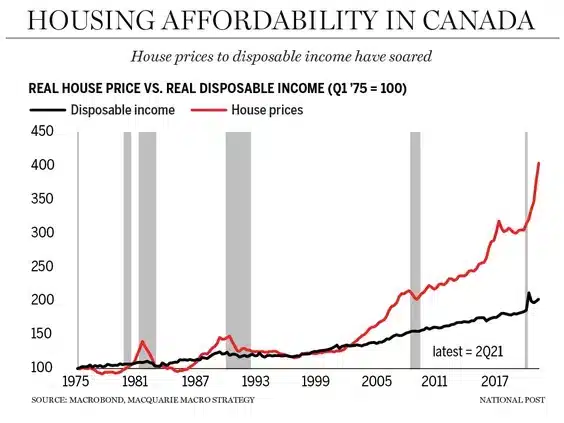
Source: Macrobond, Macquarie Macro Strategy via National Post
Chart: Real House Prices vs. Real Disposable Income in Canada (Q1 1975 = 100)
As shown above, disposable income (black line) has risen gradually since the mid-1970s — but real house prices (red line) have surged, especially after 2000. By 2021, home prices had increased more than fourfold, while income had not even doubled.
This gap is central to the housing affordability crisis. Even with moderate rate relief, many Canadians still cannot afford to enter the housing market.
6. Uncertainty Is the Central Theme
The Bank of Canada repeated one word several times during its latest press conference: uncertainty.
Between trade tensions, unpredictable inflation trends, and an unclear future for rate policy, there’s no guaranteed direction. That makes planning harder — whether you’re looking to buy, renew, or invest.
As Governor Macklem put it:
Tiff Macklem
-Governor-
-Bank of Canada-
This reflects the tone of the Bank’s current messaging: they’re cautious, non-committal, and highly aware of the complex challenges ahead.
Why This Matters
We don’t yet know where interest rates or home prices are going. But understanding how decisions from the Bank of Canada affect mortgage rates and housing affordability helps Canadians make better sense of what’s happening now — and what could be coming next.
The BoC isn’t making promises. In fact, it’s being very careful not to. That alone says a lot about the uncertainty we’re in.